
The best GoFundMe alternative depends on what supporters get back. Pick Kickstarter or Indiegogo if you're pre-selling a product (about 5% plus processing). Choose Kiva for a 0% interest loan up to $15,000. Go with Wefunder if you'll sell real equity (7.9% success fee). Use Giftabiz when friends and family simply want to gift your launch: the owner keeps 100%.
- GoFundMe charges no platform fee, but 2.9% + $0.30 comes out of each US donation.
- Kickstarter takes 5% of a successful project plus payment processing, and it's all-or-nothing: miss your goal and nobody is charged.
- Indiegogo takes 5% plus 3% + $0.20 per payment.
- Wefunder (equity crowdfunding) charges founders 7.9% of a successful raise, and you give up a piece of your company.
- Giftabiz is gifts only: the giver pays a 5% fee plus Stripe processing on top, and the owner keeps 100% of the gift.
GoFundMe is the name everyone knows, so it's the first place most founders think of when they need help getting a business off the ground. But it was built for personal causes and emergencies, not for opening a barbershop or launching a streetwear drop. Depending on what you're building and what your supporters expect in return, a different platform may fit better and cost less. Below we compare the main GoFundMe alternatives for entrepreneurs by type, fees and what you actually keep, using each platform's own published fees.
Why look for a GoFundMe alternative for your business?
Three reasons come up again and again:
- Fees come out of what you receive. On GoFundMe, 2.9% + $0.30 is deducted from every US donation, so the owner gets less than people gave (GoFundMe pricing). We break this down in Giftabiz vs. GoFundMe.
- The framing feels like a charity ask. A new food truck isn't an emergency, and many founders feel awkward asking for "donations" for a business that's meant to make money.
- Your supporters may want something specific. Some want the product, some want a stake, some just want to celebrate you. Each of those is a different kind of platform.
What are the main types of GoFundMe alternatives?
Before comparing brands, decide which category you're in. The category decides the rules, the paperwork and what your supporters get.
| Type | What supporters get | Examples | Best for |
|---|---|---|---|
| Donation | Nothing; it's a donation | GoFundMe | Personal causes, emergencies |
| Rewards (pre-sale) | The product or a perk | Kickstarter, Indiegogo | Physical products, games, creative projects |
| Lending | Their money back | Kiva | Founders who can repay over time |
| Equity crowdfunding | A share of the company | Wefunder | Businesses ready to take on investors |
| Gifting | Nothing back; it's a gift | Giftabiz | Friends and family backing a launch |
What are the best GoFundMe alternatives for entrepreneurs?
1. Kickstarter: best for pre-selling a product
Kickstarter is a rewards platform: backers pledge money and get the thing you're making, or a perk. It charges a 5% fee on successfully funded projects plus payment processing, which Kickstarter estimates at roughly 3% to 5%. Funding is all-or-nothing; if you don't hit your goal, no fees are collected and backers aren't charged (Kickstarter fees). Remember that rewards cost money to make and ship, so you keep less than the headline number.
2. Indiegogo: rewards with more flexibility
Indiegogo is also rewards-based. It charges 5% of the amount collected plus 3% of each payment and a $0.20 fixed fee per transaction in US dollars (Indiegogo fees). It suits hardware and consumer products that want to keep taking orders after the main campaign.
3. Kiva: best for a 0% interest loan
Kiva's US program offers small business loans of up to $15,000 at 0% interest, funded by individual lenders (Kiva small business lending). It's a real loan: every dollar has to be paid back. That makes it a good fit if you have steady revenue coming and want to avoid interest, and a poor fit if the money is meant to be support with no strings. Not sure whether your people are lending or giving? Read gift, loan, or investment?
4. Wefunder: best for selling equity to your community
Equity crowdfunding lets everyday people invest in your company under the SEC's Regulation Crowdfunding. A company can raise up to $5 million in a 12-month period this way, and the offering must run online through an SEC-registered broker-dealer or funding portal (SEC: Regulation Crowdfunding). Wefunder charges founders 7.9% of a successful raise plus an annual admin fee of the lesser of $1,000 or 0.5% of the amount raised (Wefunder fees). You'll also have disclosure and reporting work, and your supporters become shareholders.
5. Giftabiz: best when friends and family just want to back you
Giftabiz is built only for small business launches. Friends and family send gifts, often with a video message, to someone opening a business. It's not a loan, an investment or a rewards campaign: nothing is expected back. Under the Terms of Service, the giver pays a 5% platform fee plus Stripe processing (about 2.9% + $0.30) on top of the gift, the money goes straight to the owner's Stripe Connect account, Giftabiz never holds the funds, and the owner keeps 100% of the gift. You don't need an LLC; sole proprietors and DBAs are welcome under the community guidelines, and Stripe verifies your identity and tax details when you connect.
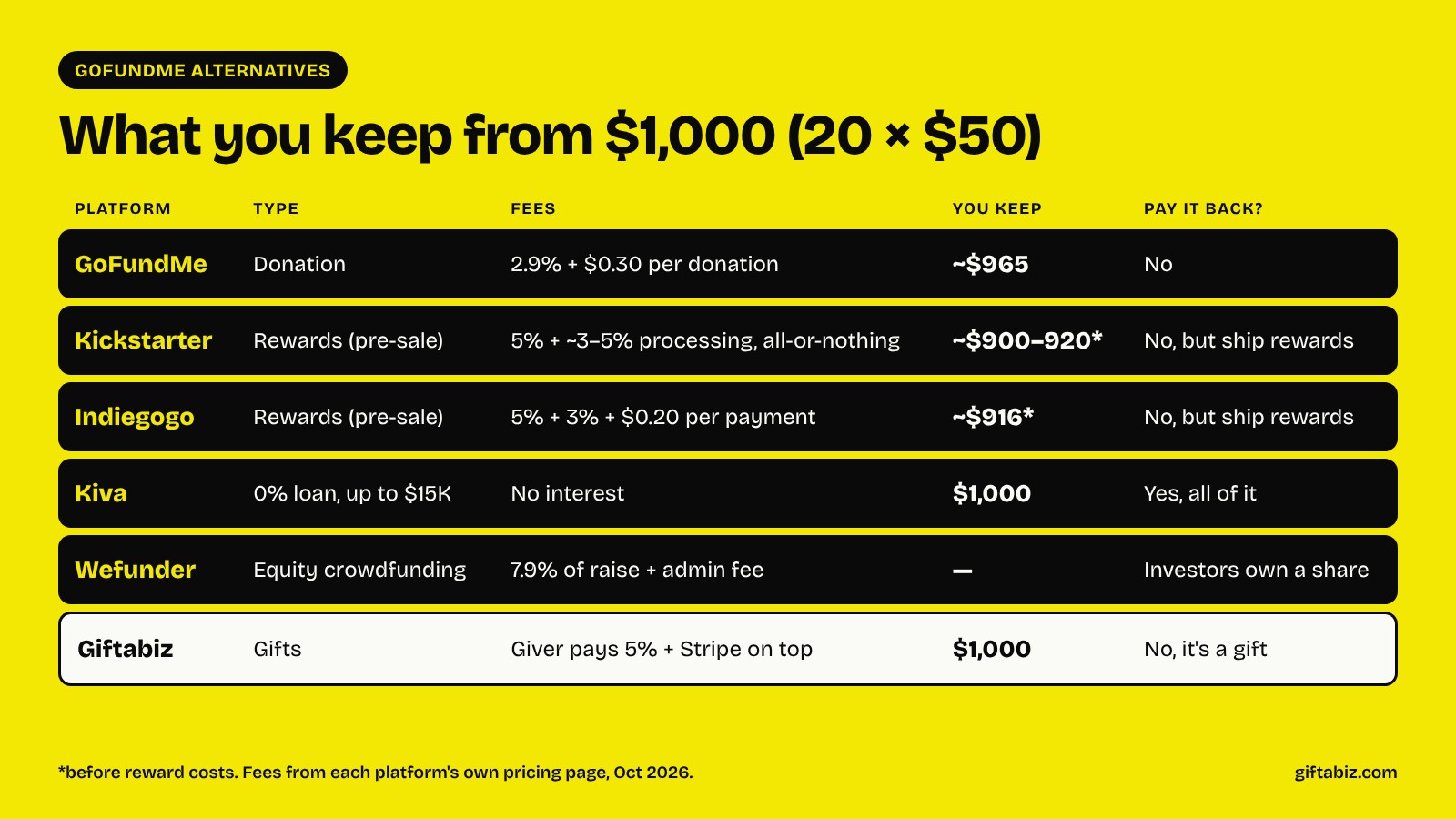
How much would you keep from $1,000 on each platform?
Here's roughly what lands with the founder when 20 people each put in $50, using each platform's published fees:
- GoFundMe: 2.9% ($29) + 20 × $0.30 ($6) = $35 in fees. You receive about $965.
- Indiegogo: 5% ($50) + 3% ($30) + 20 × $0.20 ($4) = $84. You receive about $916, before the cost of making and shipping rewards.
- Kickstarter: 5% ($50) + an estimated 3% to 5% processing ($30 to $50). You receive about $900 to $920, only if you hit your goal, and before reward costs.
- Kiva: you receive $1,000 at 0% interest, and you repay all $1,000.
- Giftabiz: you receive $1,000 and owe nothing back. Each giver covers the fees: a $50 gift costs them $52.50 (the 5% fee) plus Stripe processing.
Equity crowdfunding is left out here because Reg CF raises are usually far larger than $1,000, but the math is similar: 7.9% of a successful raise, and investors own part of your business.
Which GoFundMe alternative should you choose?
- You're making a physical product and people want one: Kickstarter or Indiegogo.
- You can repay and want to avoid interest: Kiva.
- You're ready for investors and the legal work that comes with them: equity crowdfunding such as Wefunder.
- Your people want to celebrate your launch with no strings attached: Giftabiz.
- It's a personal emergency, not a business: GoFundMe is built for that.
Many founders combine them: gifts from close friends and family for the first costs, then a pre-sale once the product is real. Whatever you pick, be clear about what kind of money it is. If someone gives you a gift, it's generally not taxable income for you (more in is gifted money taxable?), and givers can send up to $19,000 per person in 2026 without filing a gift tax return (see the gift tax limit 2026).

Launching soon? Let your people back you with gifts.
Create your Giftabiz page: one link where friends and family send real gifts and video messages, and you keep 100% of every gift. We're opening early access now.
Request early accessFrequently asked questions
What is better than GoFundMe for a business?
It depends on what supporters get back. Kickstarter and Indiegogo suit product pre-sales, Kiva offers 0% interest loans up to $15,000, equity crowdfunding like Wefunder sells shares, and Giftabiz is for friends and family who want to gift a launch with no strings.
Is Kickstarter or GoFundMe better for a small business?
Kickstarter is better if you're making a product people can pre-order, since backers get a reward. GoFundMe is better for personal causes. Kickstarter takes 5% plus processing and is all-or-nothing; GoFundMe deducts 2.9% + $0.30 per US donation.
How can I raise money for my business without a loan?
Use pre-sales through a rewards platform, gifts from friends and family, grants, or equity investors. Gifts and pre-sales don't need to be repaid; equity means giving up part of your company.
Is equity crowdfunding legal for small businesses?
Yes. Under Regulation Crowdfunding a company can raise up to $5 million in 12 months, but the offering must run through an SEC-registered broker-dealer or funding portal and comes with disclosure requirements.
Who pays the fees on Giftabiz?
The giver. They pay a 5% platform fee plus Stripe processing on top of the gift, so the business owner keeps 100% of the gift amount.
Do I need an LLC to use these platforms?
Not for Giftabiz: sole proprietors, DBAs, LLCs and corporations can all receive gifts once Stripe verifies their identity and tax details. Equity crowdfunding requires a company that can issue securities; check each platform's own rules.
Keep reading
Sources
- GoFundMe, Pricing and fees (checked October 2026).
- Kickstarter, What are the fees?
- Indiegogo, Fees (updated October 13, 2026).
- Kiva, Small business lending.
- Wefunder, How does Wefunder make money?
- U.S. SEC, Regulation Crowdfunding.
- IRS, Frequently asked questions on gift taxes.
This guide is general information, not tax or legal advice. Platform fees change; check each platform's current pricing, and talk to a tax professional or attorney before raising money from investors.