
In the US, a genuine gift is not taxable income for the person who receives it. The giver is responsible for any gift tax, and only files a gift tax return when they give one person more than $19,000 in 2026. Money received in exchange for products, services or pre-orders is business income, not a gift.
- A true gift is not income for the person receiving it under federal tax rules.
- The giver, not the receiver, is generally responsible for any gift tax.
- In 2026 a giver can give up to $19,000 per person ($38,000 for a married couple) without filing a gift tax return.
- Anything paid in exchange for a product, service, discount or pre-order is business income.
- Keep simple records showing the money was a gift with nothing expected back.
You're launching a business, and the people who love you want to help. Your aunt sends $500. Your old roommate sends $100 with a video message. Your parents chip in toward the espresso machine. It's an amazing feeling, and then the practical question shows up: do I owe tax on this? For most founders the answer is no, as long as the money really is a gift. This guide explains what counts as a gift, who pays gift tax, where the line between a gift and business income sits, and what records to keep.
What counts as a gift to the IRS?
For federal tax purposes, a gift is a transfer of money or property where the giver receives nothing of equal value in return. The IRS describes gifts in terms of the giver: you make a gift when you give something away without expecting to receive something of at least equal value back.
Courts look at the giver's intent. In a well-known 1960 case, Commissioner v. Duberstein, the US Supreme Court said a gift comes from "detached and disinterested generosity," out of affection, respect or admiration, rather than an expectation of something in return. That's exactly what happens when friends and family back your launch because they believe in you.
Signs that money is a real gift:
- The giver expects nothing back: no product, no discount, no repayment, no share of the business.
- It's given out of a personal relationship or admiration for what you're doing.
- You'd be under no obligation if the business never launched.
Who pays gift tax, the giver or the receiver?
The giver. According to the IRS gift tax FAQ, the donor is generally responsible for paying gift tax. The person receiving a gift doesn't pay income tax on it and doesn't pay gift tax on it.
In practice, almost nobody actually pays gift tax. In 2026 each giver can give up to $19,000 to any one person in a year without even filing a return. A married couple can combine their exclusions and give $38,000 to one person. Even above that, the giver simply files IRS Form 709 (due April 15 of the following year), and the amount counts against a lifetime exemption of $15,000,000 per person in 2026. Tax is only owed once lifetime gifts pass that number. Givers can see every 2026 number, with examples, in our guide to the gift tax limit for 2026.
| 2026 figure | Amount | Who it applies to |
|---|---|---|
| Annual gift tax exclusion | $19,000 per recipient | Each giver, per person they give to |
| Gift splitting (married couple) | $38,000 per recipient | Spouses giving together |
| Lifetime gift and estate exemption | $15,000,000 per person | Each giver, over their lifetime |
| Return for gifts over the annual limit | Form 709, due April 15 of the next year | The giver |
When does a gift become business income?
This is the line that matters most for founders. Money stops being a gift the moment the person gets something back for it. Under IRS rules, payments for goods and services are business income, even if they come from your mom.
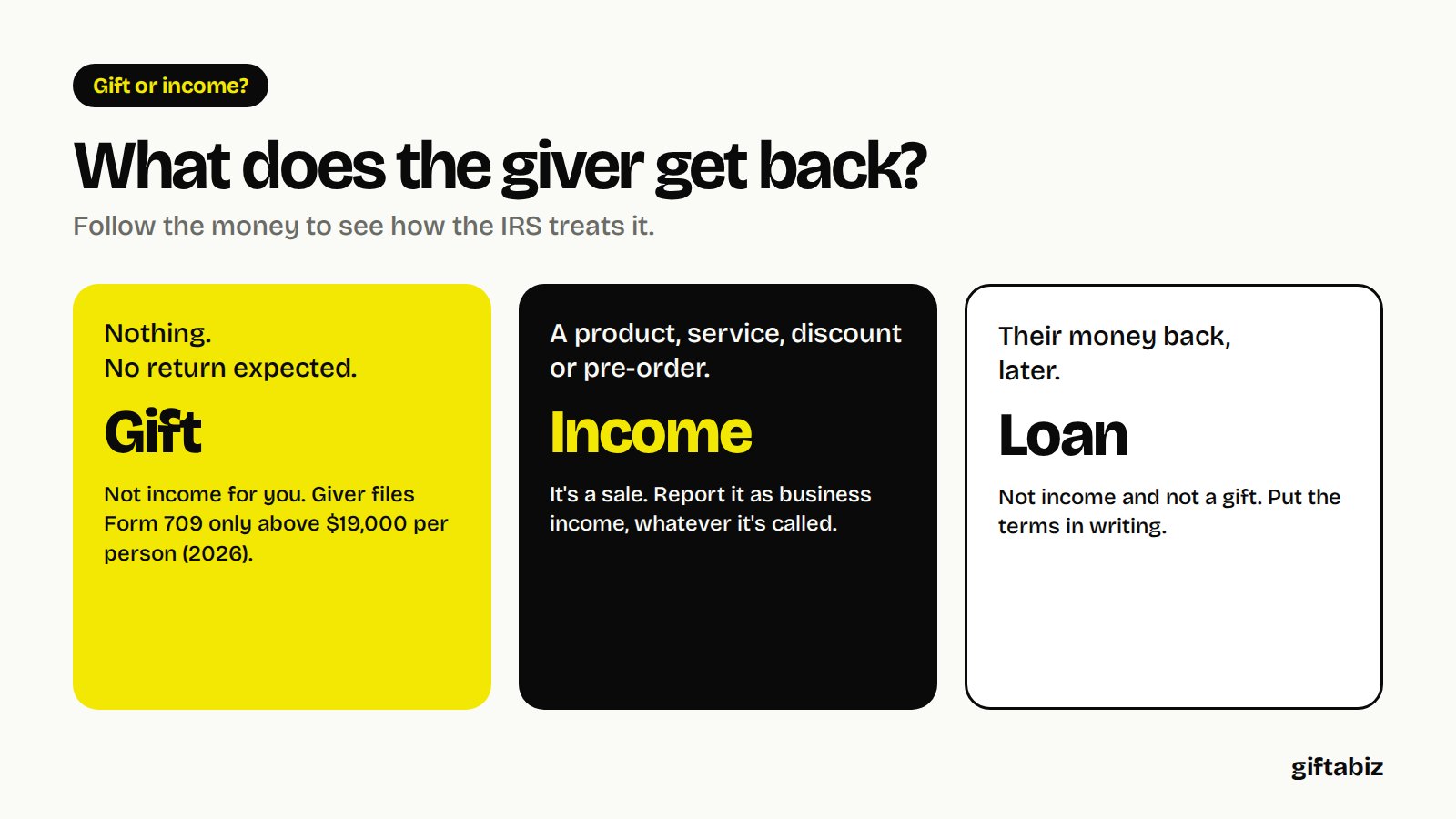
Common situations that turn "support" into income:
- Pre-orders. "Here's $200, save me a dozen cakes a month" is a sale paid in advance.
- Rewards. Money given in exchange for a t-shirt, a free class pass or a discount is a purchase, at least partly.
- Services. A friend paying you $300 for a logo you design for them is income, even if they're mainly being nice.
- A customer calling a payment a "gift". The label doesn't change the substance. If they got something, it's a sale.
And two things that are neither a gift nor income:
- A loan. If you're expected to pay it back, it's a loan, not a gift and not income. Put it in writing.
- An investment. If the giver gets a share of the business or of future profits, it's an investment with its own rules.
Does it matter if I have an LLC?
Sometimes. If you're a sole proprietor, or your business is a single-member LLC (which the IRS treats as part of you for income tax by default), money given to you personally as a gift is generally treated like any other personal gift.
It gets more technical when the money is given to a separate business entity, such as a multi-member LLC or a corporation, rather than to you as a person. Contributions to a business entity can be treated differently, so if gifts will land in a company account, ask a tax professional how to record them. You don't need an LLC to receive gifts on Giftabiz: sole proprietors, DBAs, LLCs and corporations are all welcome under the community guidelines.
Do I need to report gifted money?
A genuine gift generally doesn't go on your income tax return as income. IRS Publication 525 states that property you receive as a gift generally isn't included in your income.
One thing to know: payment processors report payments on Form 1099-K when an account passes federal thresholds, currently more than $20,000 and more than 200 transactions in a calendar year. A 1099-K doesn't make a gift taxable, but it does mean you should be able to show which payments were gifts. That's where records help.

Maria is opening a bakery in Henderson. Her uncle sends a $500 gift through Giftabiz with a video message: "So proud of you. Go get 'em." He expects nothing back.
- Maria receives: $500. Giftabiz's 5% platform fee ($25) and the card processing fee are paid by her uncle on top of the gift, so she keeps the full $500.
- Tax for Maria: none on the gift. It's not income.
- Tax for her uncle: none, and no return to file, because $500 is far below the $19,000 annual exclusion.
- What would change it: if the $500 bought him a year of free croissants, at least part of it would be a sale and business income for Maria.
How Giftabiz gifts are structured
Giftabiz was built around the gift line on purpose. Every contribution on Giftabiz is a gift: no equity, no rewards, no promised return. Under the Terms of Service:
- Givers pay a 5% platform fee on top of their gift, plus card processing, so the business owner keeps 100% of the gift.
- Payments run through Stripe Connect, and gifts go straight to the owner's connected Stripe account. Giftabiz never holds the money.
- Owners have no obligation to give anything back. Givers are cheering you on, not buying something.
- Each gift can come with a video message, which doubles as a clear record that it was a gift.
That structure keeps things simple for both sides: your people give, you build, and nobody has to wonder whether a gift was secretly a pre-order.
Launching something? Let your people back you.
Create a Giftabiz page for your launch: one shareable link, real gifts, and video messages from the people cheering you on. Free for business owners during early access.
Request early accessFrequently asked questions
Do I pay taxes on a $500 gift for my business?
No, not if it's a genuine gift with nothing expected back. Gifts aren't income for the person receiving them, and a $500 gift is far below the $19,000 annual limit that would require the giver to file a return.
Does a GoFundMe or Giftabiz gift count as income?
A genuine gift generally doesn't, whatever platform it comes through. What matters is whether the giver received anything in return, not the website used to send it.
What if a customer calls a payment a gift?
The label doesn't decide it. If the customer received a product, service or discount for the money, it's a sale and counts as business income.
Do I need to keep records of gifts?
Yes, it's a good idea. Keep who gave, when, how much and the message showing it was a gift, so you can separate gifts from sales if a processor sends you a Form 1099-K.
Is there a limit on how much someone can gift me?
No hard limit. Above $19,000 from one person in 2026, the giver files Form 709, but no tax is due unless their lifetime gifts pass $15 million.
Are gifts to my business tax-deductible for the giver?
Generally no. Gifts to a person or a for-profit business aren't charitable donations, so givers usually can't deduct them.
Keep reading
Sources
- IRS, Frequently asked questions on gift taxes (2026 annual exclusion, lifetime exemption, who pays).
- IRS, Publication 525, Taxable and Nontaxable Income (gifts and inheritances).
- IRS, Understanding your Form 1099-K.
- Commissioner v. Duberstein, 363 U.S. 278 (1960).
This guide is general information, not tax or legal advice. Tax rules depend on your situation; talk to a tax professional before making decisions.