
Decide before the money moves. A gift is never paid back and needs no paperwork up to $19,000 per person in 2026. A loan must be repaid, should be written down, and above $10,000 should charge at least the IRS Applicable Federal Rate. An investment buys a share of the business and can trigger securities rules.
- Gift: nothing comes back. In 2026 you can give up to $19,000 per person ($38,000 as a married couple) without filing a gift tax return.
- Loan: you expect repayment. Put it in writing, and for loans over $10,000 charge at least the IRS Applicable Federal Rate (AFR).
- Investment: you get ownership or a share of profits. Every offer or sale of securities, even to one relative, must be registered with the SEC or exempt.
- Interest you earn on a family loan is taxable income for you. A genuine gift isn't income for the person receiving it.
- The worst option is the vague one: money that is "kind of a loan" causes most family fallouts.
Your sister is finally opening her nail studio. Your cousin has a food truck lined up and needs a few thousand dollars for the wrap and the first inventory run. You want to help, and you have the money. The question that trips most families up is not how much, but what kind of money it is. A gift, a loan and an investment feel similar when you hand over the check. They are very different a year later, when the business is slow, or booming, and nobody wrote anything down. Here's how each one works, what the IRS cares about, and how to pick.
What's the difference between a gift, a loan and an investment?
The difference is what you expect back.
- A gift expects nothing back: no repayment, no product, no share of the business. It's support, full stop.
- A loan expects the money back, usually with interest, on a schedule you both agree to.
- An investment expects a piece of the upside: ownership (equity), a share of profits, or a right to convert into ownership later. You also share the downside, and you can lose all of it.
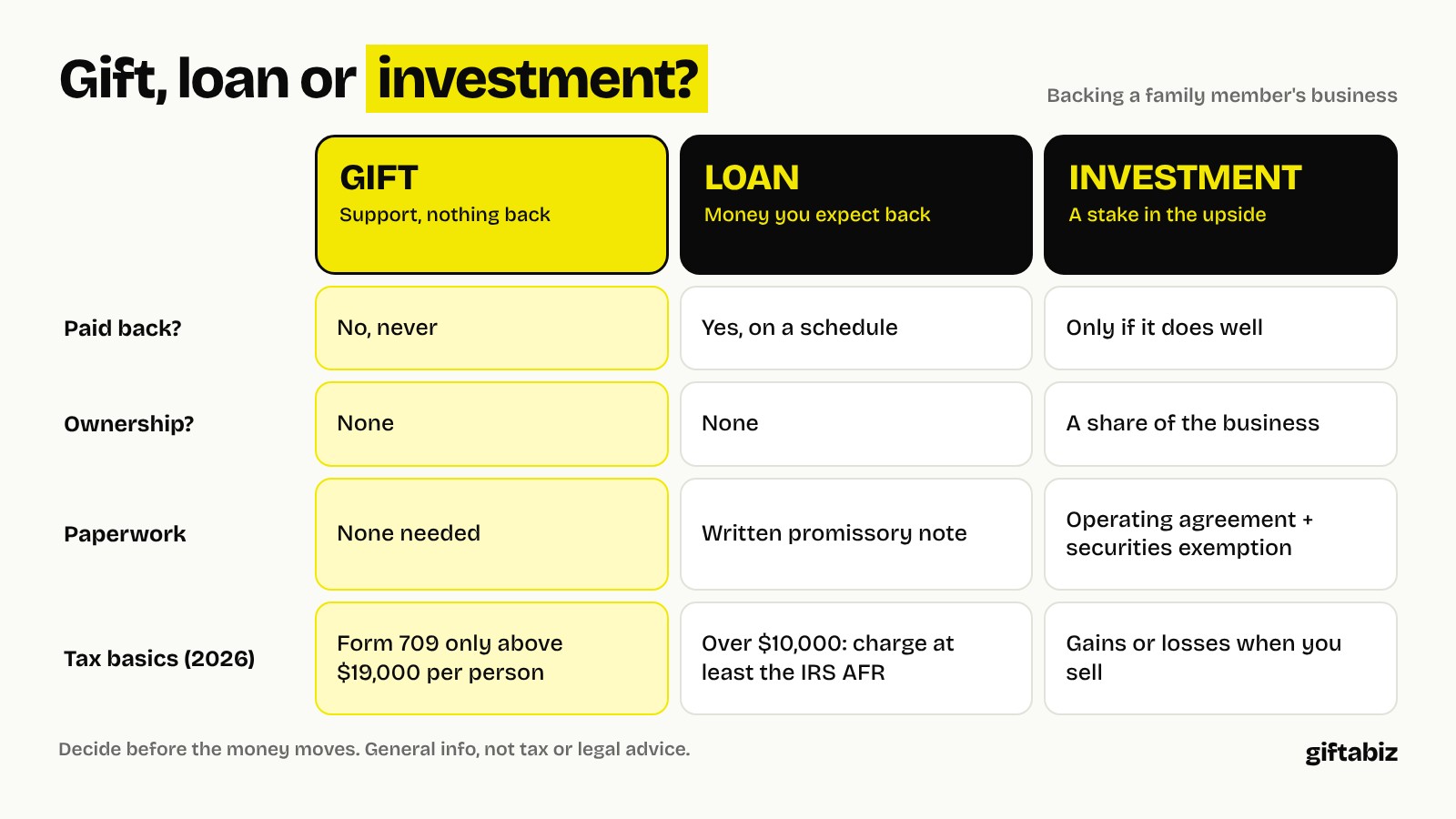
| Gift | Loan | Investment | |
|---|---|---|---|
| Paid back? | No | Yes, on a schedule | Only if the business does well |
| You own part of the business? | No | No | Yes, or a share of profits |
| Paperwork | None needed; a note or message helps | Written promissory note | Operating agreement or stock docs, often a lawyer |
| Tax basics | Over $19,000 per person in 2026: you file Form 709 | Over $10,000: charge at least the AFR; interest is your income | Securities rules apply; gains or losses when you sell |
| Best when | You can afford to never see it again | You need the money back | You want a real stake and accept the risk |
Is it better to gift or loan money to a family member?
If you can afford to let the money go, a gift is usually simpler and kinder. There is no repayment to chase, no awkward holiday dinner when a payment is late, and no tax paperwork at all for most amounts. In 2026 you can give any one person up to $19,000 without filing anything (see our gift tax limit 2026 guide for the full rules). Even above that, you just file Form 709 and the amount counts toward a lifetime exemption of $15,000,000; no tax is due until you pass it.
A loan makes sense when you'll actually need the money back, or when the amount is big enough that it would change your own plans if it disappeared. Just be honest with yourself: if you'd never really ask for repayment, call it a gift.
Do I need to charge interest on a family loan?
For small loans, generally no. The tax code has a $10,000 de minimis exception for gift loans directly between individuals (26 U.S.C. § 7872). That exception doesn't apply when the loan is directly used to buy or carry income-producing assets, which can include business equipment, so ask a tax pro if your loan funds the business itself.
For loans over $10,000, charge at least the Applicable Federal Rate. The IRS publishes these minimum rates every month on its Applicable Federal Rates page; use the rate for the month the loan is made and the loan's term (short, mid or long). If you charge less, the IRS can treat the missing interest as if you received it and then gave it away, which creates income for you and a gift on paper.
Two more things to know: the interest you receive is taxable income for you, and if you later forgive the loan, the forgiven amount is generally treated as a gift in the year you forgive it.
What should a family loan agreement include?
A simple promissory note protects the relationship as much as the money. Include:
- The amount, the date and both names.
- The interest rate (at least the AFR if over $10,000).
- The repayment schedule: monthly amount, start date, end date.
- What happens if a payment is late or the business closes.
- Signatures from both of you. Keep a record of every payment.
What if I want a share of the business instead?
Then you're an investor, and the rules change. Under federal securities law, every offer and sale of securities, even to just one person, must be registered with the SEC or fall under an exemption, and that includes friends and family (SEC: Private Companies and the SEC). Most small family deals use an exemption, but the business owner should set it up properly, usually with a lawyer and an operating agreement that spells out your percentage, voting rights and what happens if the business is sold or closes.
Investing can be a great fit for a relative who brings real money and wants real upside.
Jordan's cousin Mia needs $12,000 for counters and equipment before her boba shop opens. Here's how each option plays out:
- As a gift: Mia receives the full $12,000 and owes nothing back. It's under the $19,000 annual exclusion, so Jordan files no return. Sent through Giftabiz, Jordan would pay the 5% platform fee ($600) plus card processing on top, so Mia still keeps 100% of the $12,000.
- As a loan: they sign a note for $12,000 over three years. Because it's above $10,000, Jordan charges at least the AFR for that month, and reports the interest he receives as income.
- As an investment: Jordan takes a percentage of the business. Mia's LLC documents the stake, the offer has to fit a securities exemption, and Jordan's return depends entirely on how the shop does.

Where does Giftabiz fit?
Giftabiz lives entirely in the gift column. Every contribution is a gift: no equity, no rewards, no repayment and no promised return. Under the Terms of Service, givers pay a 5% platform fee plus card processing on top of their gift, gifts go straight to the owner's Stripe Connect account, and Giftabiz never holds the money. The owner keeps 100% of the gift.
That makes it a clean way to give: the gift is clearly labeled as a gift, and you can add a video message that doubles as a record. Business owners don't need an LLC to receive gifts; sole proprietors and DBAs are welcome under the community guidelines. If you're wondering how this looks on the owner's side, our guide on whether gifted money is taxable explains why a genuine gift isn't income for the person receiving it. And if you're comparing ways to send support, see Giftabiz vs. GoFundMe. Founders on the other side of this conversation can read how to ask friends and family to fund your business.
Know someone launching? Send them Giftabiz.
Giftabiz gives a new business one link where friends and family can send real gifts with video messages, and the owner keeps 100% of every gift. Send it to the founder in your life and they can request early access.
Send them GiftabizFrequently asked questions
Can I give my family member $19,000 for their business tax-free?
Yes, in 2026 you can give up to $19,000 to any one person without filing a gift tax return, and a married couple can give $38,000. The person receiving it doesn't pay income tax on a genuine gift.
Does a family loan need to be in writing?
It should be. A signed promissory note with the amount, interest rate and repayment schedule shows the IRS it's a real loan and keeps expectations clear for both of you.
What interest rate should I charge a relative?
For loans over $10,000, charge at least the IRS Applicable Federal Rate for the month and term of the loan. The IRS publishes the rates monthly on its Applicable Federal Rates page.
What happens if I forgive a family loan?
The forgiven amount is generally treated as a gift in the year you forgive it. If it's within the annual exclusion of $19,000 per person in 2026, there's nothing to file.
Can I change a loan into a gift later?
Yes, by forgiving it, but decide early if you can. Switching labels after the fact is where most confusion and hurt feelings come from.
Is money sent through Giftabiz a loan or an investment?
Neither. Everything sent through Giftabiz is a gift with nothing expected back: no repayment, no equity and no rewards.
Keep reading
Sources
- IRS, Frequently asked questions on gift taxes (2026 annual exclusion, gift splitting, lifetime exemption, Form 709).
- IRS, Applicable Federal Rates (AFRs) rulings.
- Cornell Law School LII, 26 U.S.C. § 7872, treatment of loans with below-market interest rates.
- U.S. SEC, Private Companies and the SEC.
- IRS, Publication 525, Taxable and Nontaxable Income.
This guide is general information, not tax or legal advice. Tax and securities rules depend on your situation; talk to a tax professional or attorney before making decisions.