
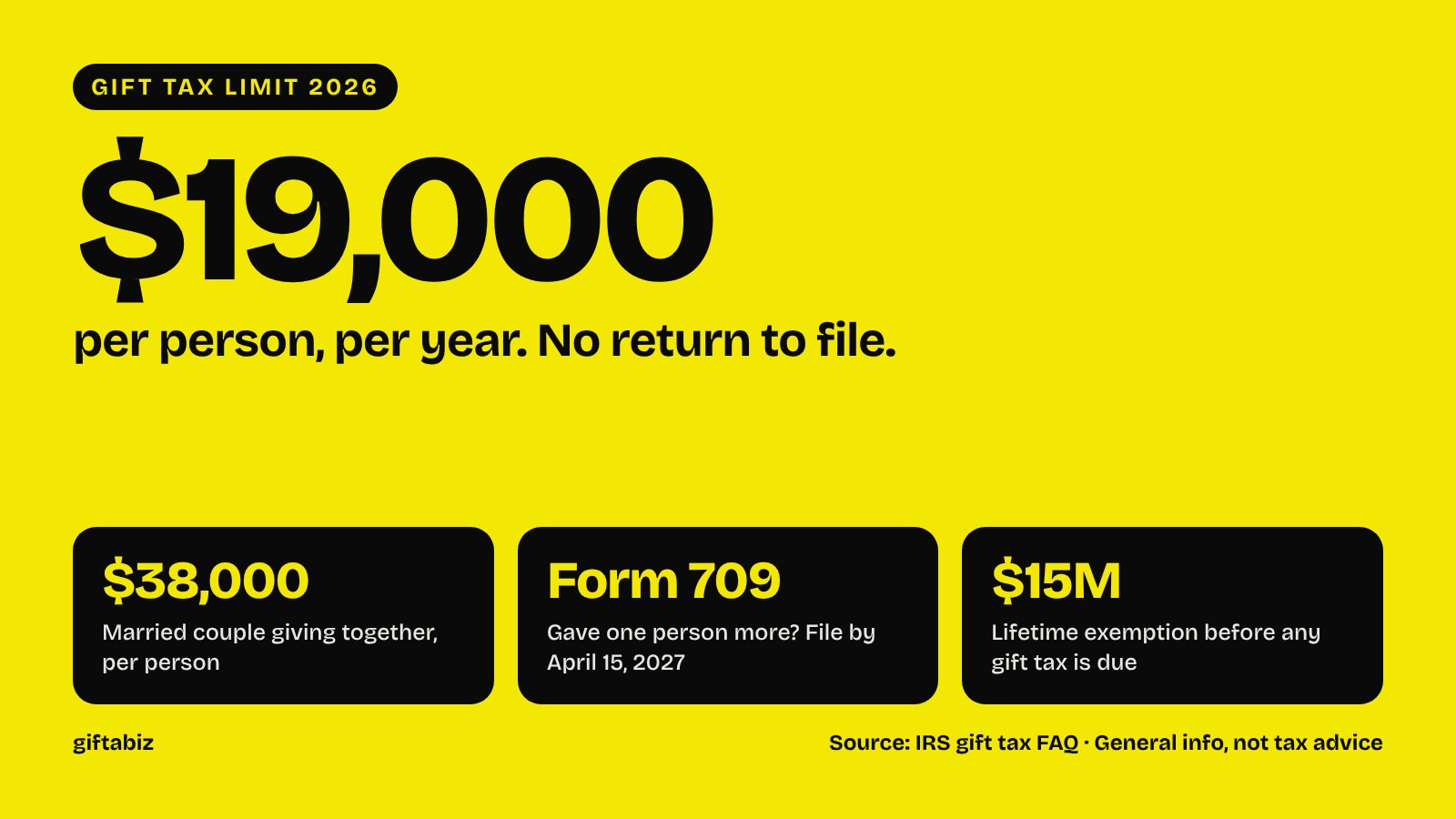
In 2026 you can give up to $19,000 to any one person, including someone starting a business, without filing a gift tax return. A married couple can give $38,000. Give more and you file Form 709, but no gift tax is due unless your lifetime gifts pass $15 million.
- Annual exclusion: $19,000 per recipient, per giver.
- Married couples: $38,000 per recipient with gift splitting.
- Over the limit? The giver files Form 709 by April 15 of the following year.
- Lifetime exemption: $15,000,000 per person before any gift tax is actually owed.
- The giver, not the founder, is generally responsible for gift tax, and the gift isn't income for the person receiving it.
Someone you love is about to open a bakery, a barbershop or a design studio, and you want to help with real money: the deposit on the lease, the espresso machine, the first batch of inventory. Before you write the check, it's natural to wonder how much you can give without running into gift tax. The good news is that the limits are generous, the paperwork is simple, and for almost everyone no tax is ever due. Here's how the 2026 gift tax limit works when the person you're backing is launching a business.
What is the gift tax limit for 2026?
The IRS calls it the annual exclusion. For gifts made in 2026, it's $19,000 per recipient, according to the IRS gift tax FAQ. Give one person $19,000 or less during the calendar year and there's nothing to file and nothing to pay.
The second number to know is the lifetime exemption, which the IRS calls the basic exclusion amount. For 2026 it's $15,000,000 per person. Gifts above the annual exclusion don't trigger a tax bill; they're simply counted against that lifetime amount. Gift tax is only due once your total lifetime gifts above the annual exclusions pass $15 million.
| 2026 gift tax figure | Amount | What it means for you |
|---|---|---|
| Annual exclusion | $19,000 per recipient | Give up to this to each person, no return needed |
| Gift splitting (married couple) | $38,000 per recipient | You and your spouse together, per person |
| Lifetime gift and estate exemption | $15,000,000 per person | Tax only after lifetime gifts pass this |
| Return for gifts over the annual limit | Form 709, due April 15, 2027 | Filed by the giver, not the founder |
Is the $19,000 limit per person or in total?
Per person. The annual exclusion applies to each recipient separately, so you could give $19,000 to your daughter, $19,000 to her business partner and $19,000 to your nephew in the same year without filing anything. There's no overall cap on how many people you give to.
It's also per giver. If your friend's launch has three backers in your family, each of them has their own $19,000 exclusion for that founder.
How much can a married couple give?
Together, a married couple can give $38,000 to one person in 2026. The simplest way is for each spouse to give $19,000 from their own funds, which keeps you both under the limit with nothing to file.
If the whole $38,000 comes from one spouse's account, you can still treat it as given half by each of you. That's called gift splitting, and you make the election on Form 709. So it costs nothing in tax, but it does mean a return.
What happens if I give more than $19,000?
Nothing scary. You file IRS Form 709, the gift tax return, by April 15 of the year after the gift. The amount above $19,000 is subtracted from your $15 million lifetime exemption. No check goes to the IRS unless you've already used up that exemption.
Lena wants to help her nephew Marcus buy the kitchen equipment for his new food truck. In 2026 she gives him $25,000 and expects nothing back.
- Covered by the annual exclusion: $19,000.
- Above the exclusion: $6,000, which Lena reports on Form 709 by April 15, 2027.
- Lifetime exemption left: $15,000,000 − $6,000 = $14,994,000.
- Gift tax owed: $0. Income tax for Marcus: $0, because a gift isn't income.
- No-return alternative: Lena gives $19,000 and her husband gives $6,000 from his own funds. Both stay under the limit, so neither files.
Does the founder pay tax on the money I give?
No, not if it's a genuine gift. IRS Publication 525 says gifts generally aren't included in the recipient's income, and the IRS FAQ says the giver is generally the one responsible for any gift tax. So your gift doesn't create a tax bill for the person launching.
The important word is genuine. If you get something back, such as a year of free haircuts, a discount or a share of profits, at least part of the money stops being a gift. For the founder's side of this, read Is gifted money taxable for a small business owner?
Does it matter if I give to the person or to their business?
It can. A gift to your friend personally, including one who runs their business as a sole proprietor or single-member LLC, is treated like any other personal gift. Money sent to a separate company, such as a multi-member LLC or a corporation, can be treated differently for gift tax purposes, so ask a tax professional before giving a large amount directly to an entity.
The IRS also excludes some payments completely. Tuition paid directly to a school and medical bills paid directly to a provider don't count toward the $19,000 at all. Those rarely apply to a business launch, but they're useful to know.
Can I deduct a gift to someone's new business?
Generally no. The IRS is clear that you can't deduct the value of gifts you make, except for contributions to qualifying charities. A for-profit launch isn't a charity, so a gift to a founder won't reduce your income tax.
What if I want the money back someday?
Then it isn't a gift. If you expect repayment, it's a loan, and it should be written down with a repayment plan. If you expect a share of the business, it's an investment, which comes with its own rules. Decide which one you mean before the money moves, and say it out loud. It saves a lot of awkwardness later.

How do I send a launch gift?
A check or bank transfer works fine for a large gift. For the many smaller gifts friends and family send around a launch, Giftabiz was built for exactly this moment. Under our Terms of Service, the giver pays a 5% platform fee plus Stripe card processing on top of the gift, and the business owner keeps 100% of the gift, paid straight to their own Stripe Connect account. Giftabiz never holds the money, and each gift can come with a video message.
On a $500 gift, for example, you'd add the $25 platform fee plus processing, and the founder receives the full $500. Wondering how that compares with a fundraiser site? See Giftabiz vs. GoFundMe for the fees on a $100 gift.
Know someone launching? Send them Giftabiz.
Giftabiz gives founders one link where friends and family can send real gifts and video messages, and the owner keeps 100% of every gift. We're in early access: share it with the founder in your life.
Send them GiftabizFrequently asked questions
How much money can I give someone in 2026 without paying taxes?
You can give up to $19,000 to each person in 2026 without filing a gift tax return. Above that you file Form 709, but no gift tax is due until your lifetime gifts pass $15 million.
How much can parents give a child to start a business in 2026?
Two parents can give $38,000 to one child in 2026 without using any lifetime exemption, or $76,000 if they also give $38,000 to the child's spouse. Larger gifts just require Form 709.
Do I have to report a $25,000 gift?
Yes. A single giver who gives one person more than $19,000 in 2026 files Form 709 by April 15, 2027. The extra $6,000 counts against the $15 million lifetime exemption, and no tax is due.
Does the person receiving a gift have to pay tax on it?
Generally no. Gifts aren't income for the recipient, and the giver is generally responsible for any gift tax, which almost no one owes in practice.
Is the gift tax limit per year or lifetime?
Both. The $19,000 annual exclusion resets every year for each recipient, while the $15 million lifetime exemption tracks the total of your gifts above those annual amounts.
Is a gift to a friend's business tax-deductible?
No. Gifts to a person or a for-profit business aren't charitable contributions, so you can't deduct them on your income tax return.
Keep reading
Sources
- IRS, Frequently asked questions on gift taxes (2026 annual exclusion of $19,000, $38,000 for spouses, $15,000,000 basic exclusion amount, who pays, educational and medical exclusions, deductibility). Checked October 20, 2026.
- IRS, About Form 709, United States Gift (and Generation-Skipping Transfer) Tax Return.
- IRS, Publication 525, Taxable and Nontaxable Income (gifts are generally not income).
- Giftabiz, Terms of Service §7 (5% platform fee and Stripe processing paid by the giver; Stripe Connect payouts).
This guide is general information, not tax or legal advice. Tax rules depend on your situation; talk to a tax professional before making a large gift.